
Two-Piece vs Four-Piece Kayak Paddles: Which is Best for Travel and Storage?
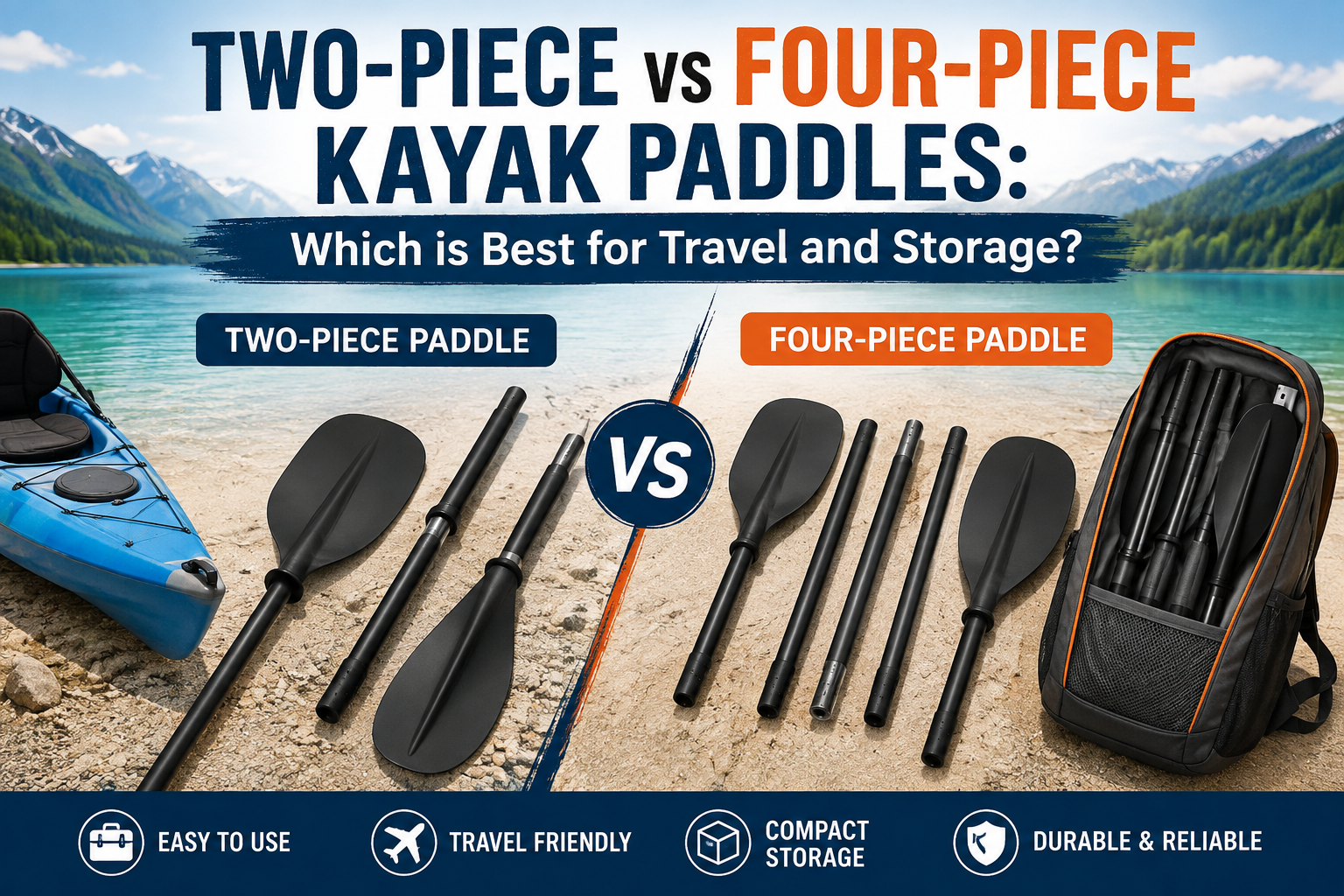
Choosing between a two piece kayak paddle and a four-piece model comes down to one simple trade-off: how much you value quick assembly versus how much you value a smaller, more packable size. If you're flying with your gear, storing it in a small vehicle, or backpacking to a put-in spot, this decision matters just as much as the paddle's material or length. At Vibe Kayaks, we get asked constantly which breakdown style actually makes sense for real trips, so here's a straightforward comparison to help you decide.
This guide pairs well with our broader breakdown of how to paddle a kayak, since paddle format is really just one more piece of the sizing and gear puzzle.
Two-Piece vs Four-Piece Paddles: The Basic Difference
A two-piece paddle splits into two shaft halves that join at a single ferrule (the connector joint), usually near the center. A four-piece paddle breaks down into four sections, splitting both the shaft and each blade separately.
The core two piece vs four piece paddle pros and cons comes down to this: fewer sections mean faster assembly and a more rigid feel, while more sections mean a smaller packed size at the cost of slightly more setup time and marginally more flex at the joints.
Two-Piece Kayak Paddles: Pros and Cons
Advantages
- Faster to assemble, typically a single twist-lock or push-button connection
- Stiffer overall feel, since there's only one joint instead of three
- Generally more affordable than comparable four-piece models
- A reliable everyday choice for anyone who doesn't need to pack it small
Drawbacks
- Packed length is roughly half the paddle's full length, which can still be too long for tight trunks, small kayaks, or checked luggage
- Less convenient for backpacking or multi-modal travel where every inch of pack space counts
Four-Piece Kayak Paddles: Pros and Cons
Advantages
- Packs down to roughly a quarter of the paddle's full length, ideal for backpacking, air travel, or storing in compact spaces
- Easier to fit into a kayak's internal storage hatch for spare or emergency paddles
- Often available as a genuinely collapsible kayak paddle for backpacking, small enough to strap to a pack
Drawbacks
- More assembly steps and connection points before you're ready to paddle
- Slightly more potential flex at the joints compared to a two-piece design, though quality four-piece paddles minimize this
- Typically priced higher than an equivalent two-piece paddle
Two-Piece vs Four-Piece: Quick Comparison
When you line the two formats up side by side, the differences come down to a handful of practical factors. A two-piece paddle packs down to roughly half its full length, assembles in seconds with a single joint, feels slightly stiffer on the water, and generally costs less, making it the more affordable pick for everyday, vehicle-based trips. A four-piece paddle packs down much further, to around a quarter of its full length, but takes a little longer to assemble across its three joints, carries marginally more flex, and typically comes with a higher price tag. That extra cost and setup time is the trade-off for a paddle small enough to handle backpacking, flying, or tight storage spaces.
Choosing the Best Travel Kayak Paddle for Your Trip
The right travel kayak paddle depends less on brand and more on how you're actually getting to the water:
- Driving with kayak gear in the trunk or truck bed – A two-piece paddle is usually plenty compact
- Flying, backpacking, or hiking to a launch point – A four-piece paddle's smaller packed size makes a real difference
- Storing a spare paddle inside a kayak hatch – A four-piece breaks down small enough to fit where a two-piece often won't
If you're still narrowing down the right paddle overall, it's worth confirming the correct shaft length for your height and kayak's width before deciding between two-piece and four-piece formats, since both styles come in the same range of sizes.
Does Breakdown Style Affect Performance?
For most paddlers, a well-made two-piece or four-piece paddle performs nearly identically on the water. The small amount of extra flex in a four-piece design is rarely noticeable during normal paddling, and it becomes even less relevant once you've settled into a smooth, torso-driven stroke rather than relying on raw arm strength for power.
Material Still Matters More Than Breakdown Style
Whether you choose two-piece or four-piece, the shaft material has a bigger impact on weight and feel than the number of sections does. A carbon kayak paddle in either format will still be noticeably lighter than an aluminum equivalent, so if you're comparing paddle materials side by side, it's worth doing that alongside your breakdown-style decision rather than treating them separately.
Final Thoughts
There's no universally best kayak paddle format, only the one that matches how you travel. A two-piece paddle is faster to assemble and slightly more affordable for everyday, vehicle-based trips, while a four-piece paddle earns its higher price tag for backpackers, flyers, and anyone who needs the smallest possible packed size. Browse our full lineup of kayak paddles to compare two-piece and four-piece options across materials and lengths.
Questions fréquemment posées
1. What is the best travel kayak paddle that breaks down small?
A four-piece paddle typically offers the smallest packed size, often around a quarter of its full length, making it the better choice for flying, backpacking, or fitting inside a kayak's storage hatch.
2. What are the pros and cons of a two-piece vs four-piece paddle?
A two-piece paddle assembles faster and feels slightly stiffer but packs down to about half its length. A four-piece paddle packs much smaller for travel but takes a bit longer to assemble and may have marginally more flex at the joints.
3. Is a collapsible kayak paddle good for backpacking?
Yes, a four-piece collapsible paddle is generally the best option for backpacking, since it breaks down small enough to strap to a pack or fit inside a bag alongside other gear.
4. Which kayak paddle is easiest to pack and travel with?
A four-piece paddle is the easiest to pack for travel due to its smaller broken-down size, though a two-piece paddle is still reasonably travel-friendly for car-based trips with more storage space.
5. Does a four-piece paddle perform worse than a two-piece paddle?
Not meaningfully. Quality four-piece paddles are engineered to minimize joint flex, and most paddlers won't notice a performance difference during normal use.
 Satisfait ou remboursé sous 30 jours
 Boutique en ligne sécurisée et certifiée
 Plus de 1000 clients satisfaits