
Kayak Anchor Pole: Why Shallow-Water Anglers Are Switching in 2026
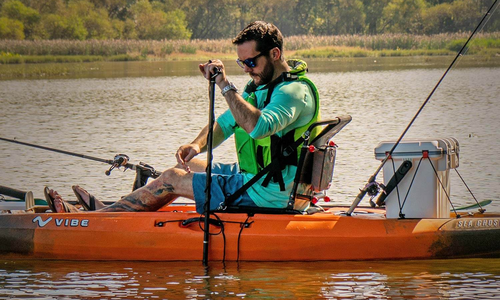
Kayak fishing has changed fast. Anglers today are running fish finders, GPS units, anchor trolleys, and dialed-in storage systems, which means a generic anchor just doesn't cut it anymore. That shift is exactly why the kayak anchor pole has become one of the most talked-about upgrades in shallow-water fishing circles this year. Instead of splashing a weighted anchor and hoping it grabs, more anglers are staking directly into the bottom for a silent, precise hold. At Vibe Kayaks, we're breaking down what's actually driving this trend, what separates a smart anchor pole for kayak use from a gimmick, and how to decide if a kayak pole anchor belongs in your setup.

The Trend: Why Stake-Out Poles Are Replacing Traditional Anchors
The kayak fishing community has moved past the old "three-pound folding anchor" era. That style of anchor often drags, snags, or lets your kayak swing over the exact fish you're trying not to spook. In its place, more anglers are adopting a two-tool strategy:
-
A stake-out pole for shallow water (typically under 6 feet deep)
-
A traditional anchor for deeper water or stronger current
This combo approach, rather than relying on one anchor for every situation, is quickly becoming the standard among serious kayak anglers because it matches the tool to the conditions instead of forcing one system to do everything.
What Makes a Kayak Anchor Pole Different From a Regular Anchor
An anchor pole for kayak is a rigid rod, usually fiberglass or aluminum, that you push straight into the lake or river bottom. Instead of relying on weight and rope, it holds your position through direct ground contact.
1. Depth Matters More Than People Realize
Most poles are only effective up to about 6 feet of water, and you'll want roughly 2-3 feet of pole above the surface for grip and leverage. A 7-foot pole hits a practical sweet spot: enough length for real flats and grass-bed fishing, without becoming unwieldy to store or deploy.
2. The Sight-Fishing Connection
One reason this gear category is trending: sight fishing has exploded in popularity, and stake-out poles are almost purpose-built for it. There's no splash, no swinging rope, and no drift to blow out a school you can visually track. You push in, hold, and reposition the moment fish move.
3. Bottom Type Changes the Equation
Not every bottom favors a pole. Grass beds, mud, and soft sediment allow quick, clean insertion and extraction. Hard-packed sand or rocky bottoms can make traditional anchors, or a hybrid rigging approach, more practical.

What to Look for in a Kayak Pole Anchor (Beyond the Marketing)
A lot of anchor poles on the market compete purely on price. Here's what actually determines whether one performs on the water.
-
Material integrity - Fiberglass resists corrosion and flexes under pressure better than most aluminum options, especially in saltwater
-
Breakdown design - A multi-piece pole (like a 3-piece build) solves the single biggest complaint anglers have with 8-foot single-piece poles: they simply don't fit in a kayak hull
-
Secure mounting - Scupper-hole compatibility or a dedicated track mount lets you deploy without standing or leaning
-
Retention - A lanyard or leash matters, since most non-buoyant poles sink immediately if dropped
A Smarter Way to Decide: Match the Pole to Your Water
Rather than buying based on a spec sheet alone, run your own conditions through this quick framework:
1. Is your typical water depth under 6 feet? If yes, a pole will outperform a traditional anchor most days.
2. Are you fishing grass, mud, or soft bottom? Poles excel here.
3. Do you need to reposition often while sight fishing? A pole's speed advantage is significant.
4. Do you regularly fish deeper water or strong current? Keep a traditional anchor as a backup rather than relying on a pole alone.
This is the same logic experienced kayak anglers use, and it's a better predictor of satisfaction than length or price alone.

Where the Vibe Anchor Pole Fits In
The Vibe Anchor Pole is a 7-foot, 3-piece fiberglass build made for anglers who want the shallow-water precision of a stake-out pole without sacrificing storage space. The breakdown design solves the fit problem that plagues longer single-piece poles, while the fiberglass construction holds up to repeated use in both fresh and saltwater. It's built around the same principle driving the broader shift toward pole anchoring: stop fighting your gear, and start matching your gear to the water in front of you.
Questions fréquemment posées
Q1: How deep can you use a kayak anchor pole?
A: Most poles are effective in water up to about 6 feet deep, with roughly 2-3 feet needed above the surface for grip and control.
Q2: Should I get a stake-out pole or a traditional anchor?
A: Many kayak anglers now carry both. A pole handles shallow water, sight fishing, and quiet positioning, while a traditional anchor covers deeper water and stronger current.
Q3: Why is fiberglass preferred for kayak anchor poles?
A: Fiberglass resists corrosion, holds up well in saltwater, and flexes under pressure instead of bending permanently, unlike many aluminum poles.
Q4: Does a kayak anchor pole float if I drop it?
A: Most fiberglass and aluminum poles will sink if dropped, so using a lanyard or leash to secure the pole to your kayak is strongly recommended.
Q5: What bottom types work best with a kayak pole anchor?
A: Soft bottoms like mud, sand, and grass beds allow the easiest insertion and extraction. Hard or rocky bottoms are better suited to a traditional anchor.
 Satisfait ou remboursé sous 30 jours
 Boutique en ligne sécurisée et certifiée
 Plus de 1000 clients satisfaits